
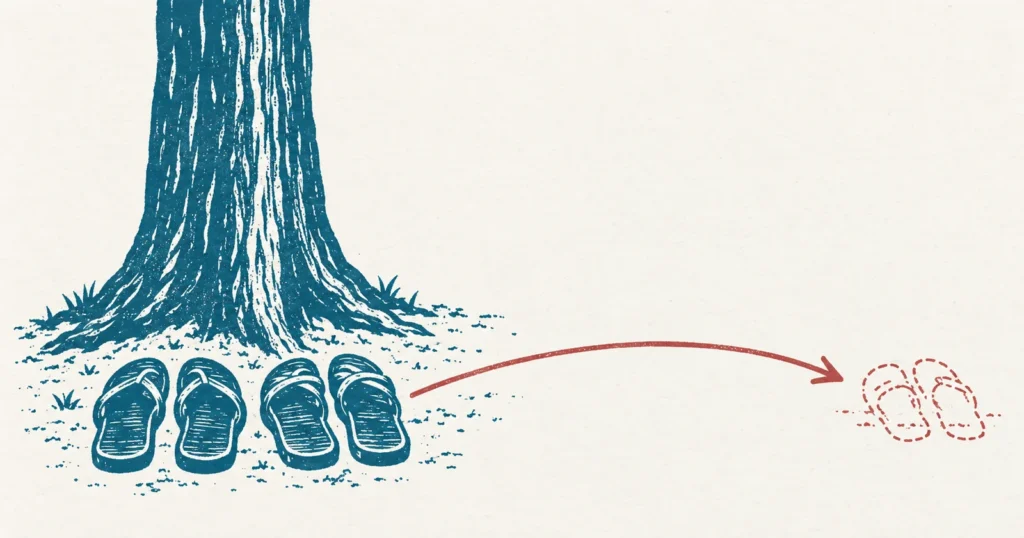
The picture has him walking up afterwards, told about it, handed a fruit already bitten. The Hebrew puts him at her elbow for the whole conversation, in two words most English readers skim past.
And when the woman saw that the tree was good for food, and that it was pleasant to the eyes, and a tree to be desired to make one wise, she took of the fruit thereof, and did eat, and gave also unto her husband with her; and he did eat.
Genesis 3:6 (KJV)
With her. It is a single word in Hebrew, immah, sitting between her husband and he did eat, and it has been in the text as long as we have had the text.
Michelangelo had him reaching for it himself
When I have taught this chapter I have put Eve at the center of it and Adam somewhere off to the side, which is not in the text and not in the great paintings either. Michelangelo put him at the tree with his own hand in it, and Dürer’s 1504 engraving stands them shoulder to shoulder, Eve taking the fruit from the serpent and Adam’s arm already out for his turn. I had seen both and still taught the scene with Adam arriving afterwards, because a habit of reading hands the interesting failure to whoever is speaking.
The word was there the whole time. Three letters in Hebrew, two words in my English Bible, and I read past them for years because the picture in my head was louder than the line on the page.
The serpent was speaking in the plural the whole time
The chapter says twice that the serpent spoke to the woman, and every you in his mouth is plural, from his first question on.
Hath God said ye shall not eat of every tree, he opens with. Ye shall not surely die. Your eyes shall be opened, ye shall be as gods. The King James ye is doing real work there, because the Hebrew behind every one of those yous and yours is second person plural. He addressed her, and he spoke as though a second pair of ears was in range.
That is corroboration rather than proof. Hebrew uses masculine plurals for mixed company, and the prohibition covered both of them, so plural would be natural in a conversation about a shared rule. It leans the same way as immah without settling anything on its own.
The Latin that Europe read has no with her
Here is the likeliest source of the picture, and it shows up the moment you compare the versions.
The Septuagint, translating from Hebrew some centuries before Christ, keeps it: meta autes, with her. The Hebrew manuscripts keep it. The King James keeps it, and so do ten of the twelve modern English versions I checked. The Contemporary English Version goes furthest and makes a sentence of it: her husband was there with her. The two that drop it are the Good News Translation and The Message, the two that paraphrase most freely.
The Clementine Vulgate does not. Its line runs deditque viro suo, qui comedit, which is simply: and she gave to her husband, who ate. No with her, no elbow, nobody standing there.
The hole is older than that text. Wycliffe made the first English Bible out of the Latin two centuries before the Clementine, and his verse ends and gave to her husband, and he ate. For all those centuries the sentence read aloud in church was short one word, and preaching fills a gap the way people do. Then in 1979 the Vatican’s own revision put the word back: the Nova Vulgata reads deditque etiam viro suo secum, qui comedit, and a revision only adds what was not there.
God calls the man first
And the LORD God called unto Adam, and said unto him, Where art thou?
Genesis 3:9 (KJV)
The woman ate first and the man is questioned first. That is odd if he had been away and came back to a mess. God works down the line from him, and the order of the questioning matches the order of the responsibility and not the order of the eating.
The charge has two halves
Then God says this to him directly, afterwards.
And unto Adam he said, Because thou hast hearkened unto the voice of thy wife, and hast eaten of the tree, of which I commanded thee, saying, Thou shalt not eat of it: cursed is the ground for thy sake; in sorrow shalt thou eat of it all the days of thy life;
Genesis 3:17 (KJV)
Because thou hast hearkened unto the voice of thy wife. That clause does not by itself put him at her elbow, and I am not going to make it: hearkening to a voice is Hebrew’s ordinary way of saying you did what you were told, and Genesis uses the same words of Abram taking Sarai’s suggestion. The charge has a second half, and the second half is the one that bites. Of the tree, of which I commanded thee.
Adam’s own defense reaches for the same preposition. He tells God it was the woman whom thou gavest to be with me, which is the phrase he uses while explaining why the thing is not his fault.
The arrangement it removes
It removes a comfortable arrangement in which one party is deceived and the other is merely weak.
Paul says Adam was not deceived, in 1 Timothy 2:14, and readers usually take that as a comment on Eve. Put it beside a man standing at her shoulder through the whole exchange and it becomes a much heavier sentence about him. Nobody tricked him. He listened to the serpent widen the prohibition, listened to his wife add a clause, heard the promise about being as gods, and said nothing at any point.
Then he ate, and Paul writes elsewhere that sin entered the world by one man.
Which makes the silence the thing worth sitting with. He had been given the rule directly, before she existed. He was the only person in the garden who had heard it from God rather than secondhand, and he was standing close enough to correct the account twice and did not. Knowing the procedure and doing nothing is a recognizable condition, and it is older than the church.
The quiet man in the scene
There is no villain shortage in Genesis 3. What the chapter has that the retelling loses is a second person present through all of it, saying nothing while a rule he had been given directly was being enlarged, then contradicted, then broken.
The chapter is full of people improving on what God said. Adam neither improves on it nor corrects it, and what Genesis 3:17 charges him with is having done what she said and eaten from the one tree he had been told about himself.