
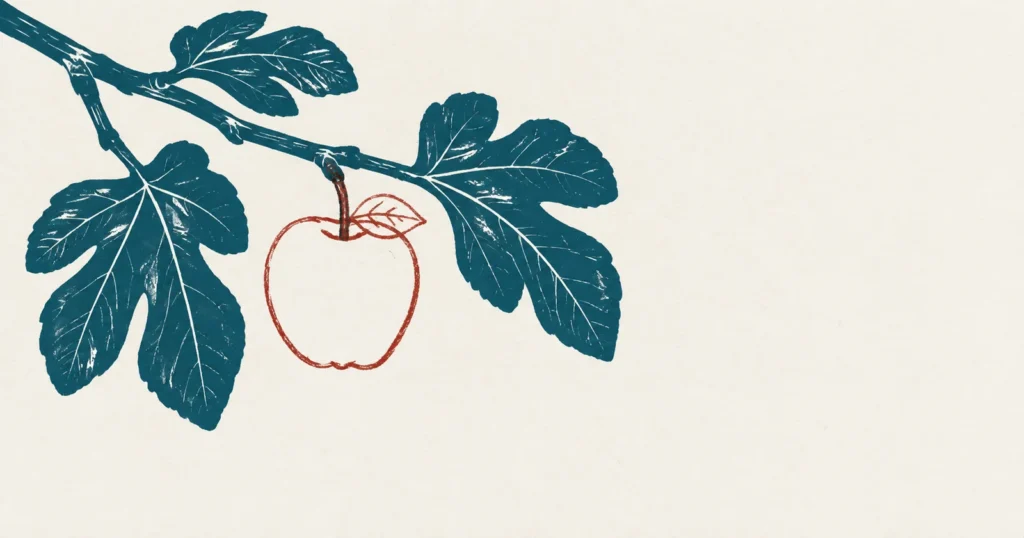
Red and round, and usually in her hand. Genesis never says what it was. The Hebrew word in the sentence where she eats is peri, which is the ordinary word for fruit and carries no species in it at all.
Latin supplied the apple, not Hebrew
The tree is named in the sentence that forbids it.
But of the tree of the knowledge of good and evil, thou shalt not eat of it: for in the day that thou eatest thereof thou shalt surely die.
Genesis 2:17 (KJV)
Now the same line in the Latin that most of Europe read for a thousand years: de ligno autem scientiae boni et mali. The tree of the knowledge of good and of evil, and the Latin for evil there is mali.
The Latin for evil is malum, with a short a. With a long one, mālum is a fruit, and the dictionary gives it as any tree-fruit fleshy outside with a kernel within, apples and quinces and pomegranates together. The spellings are identical, and manuscripts did not mark vowel length. A reader meeting that sentence in Latin has a fruit word sitting inside the tree’s name, and the painters settled it on the apple.
It is a pun, not a translation error, and it did what puns do.
The only tree named is a fig
One verse after the eating, the scene supplies its one piece of botany, and it is not a fruit.
And the eyes of them both were opened, and they knew that they were naked; and they sewed fig leaves together, and made themselves aprons.
Genesis 3:7 (KJV)
Figs, for the leaves. Whether the same tree bore the fruit, the text does not say and shows no interest in saying. The rabbis who argued about it named wheat, grapes, a citron and figs, and the figs are the one species the chapter itself mentions. Michelangelo painted a fig on the Sistine ceiling, which is closer to the text than the apple everybody remembers.
Everybody in the scene supplies a detail
This is the part worth the reading, and it is sitting there in plain sight.
God’s instruction is generous before it is restrictive. Of every tree of the garden thou mayest freely eat, says 2:16, and then the one exception. Freely eat, and one tree withheld.
The serpent opens by turning that inside out. His first line is a question: hath God said, ye shall not eat of every tree of the garden? Which is not what God said. God had permitted every tree but one, and the serpent’s version has him forbidding the lot. The conversation begins with the prohibition inflated, and the woman is now defending a rule larger than the one she was given.
She answers him, and by the time the sentence leaves her, another clause has been added.
But of the fruit of the tree which is in the midst of the garden, God hath said, Ye shall not eat of it, neither shall ye touch it, lest ye die.
Genesis 3:3 (KJV)
Neither shall ye touch it. God never said that. Go back to 2:17 and it is not there, and it is not anywhere else either. The first time a human being quotes God in the Bible, the quotation is wrong, the error is an addition, and it makes the rule stricter rather than looser. It comes from the person keeping the rule.
She also takes something out. The King James margins preserve how God said both halves of it: eating thou shalt eat, and dying thou shalt die. Hebrew doubles the verb like that for emphasis, and God had used the doubling on the permission and on the penalty alike. In the same breath that makes the rule stricter, her version flattens both of them: we may eat, she says, and lest ye die.
Then the serpent performs the opposite operation, and he does it with God’s own words. He puts the doubled verb back and sets a negative in front of it: ye shall not surely die.
Count the moves. The prohibition is widened, a clause is added to it, the permission and the penalty are both flattened, and then the penalty is cancelled outright, all of it before anybody touches the tree. Nobody in the scene is quoting accurately, and the one who started it is the one who benefits.
And then we added a fruit
Which is the joke of the whole question, if it is a joke. The chapter is about what happens when people improve on what God actually said, and the detail everybody argues about is one we supplied ourselves, several languages downstream, out of a coincidence between two Latin words.
Nobody is worse off for picturing an apple, and the picture is not the problem. The habit that produced it is the subject of the chapter the picture illustrates. A strange thing for a painting to do to itself.
Her reasons are given in full
The woman’s reasons are set out plainly, and none of them is about flavor.
And when the woman saw that the tree was good for food, and that it was pleasant to the eyes, and a tree to be desired to make one wise, she took of the fruit thereof, and did eat, and gave also unto her husband with her; and he did eat.
Genesis 3:6 (KJV)
Good for food, pleasant to the eyes, desirable for wisdom. Three reasons, and the third is the one doing the work, because the serpent had promised that eyes would open and they would be as gods, knowing good and evil.
What she wanted was not a piece of fruit. It was a promotion, and the tree was the paperwork.
And the promise was kept, in the way such promises are kept. Their eyes were opened, exactly as the serpent said. What the opened eyes showed them was that they were naked, which is a fact they had been living inside all along without it costing them anything. They got the knowledge and the first thing it did was make them hide.
The chapter’s last word on it is God’s own, and it is the one line in the chapter that nobody had to improve. At 3:5 the serpent had said ye shall be as gods, knowing good and evil. At 3:22 God says behold, the man is become as one of us, to know good and evil.
Tradition fills in an innkeeper where Luke has none, a trade for a woman the Gospels never accuse, and a species for a fruit Genesis leaves alone. Most such additions cost nothing and some cost a great deal, and the only way to tell them apart is to know what the text said before anybody helped.