
Tape Luke 6:38 to the food-drive box by a church door at Thanksgiving, and the verse is in the right place. Yes, the Bible says it, in those words: “Give, and it will be given to you.” Jesus says it as the last of a run of commands that begins with “love your enemies,” and a few lines earlier he tells the same people to lend and expect nothing back. He means both.
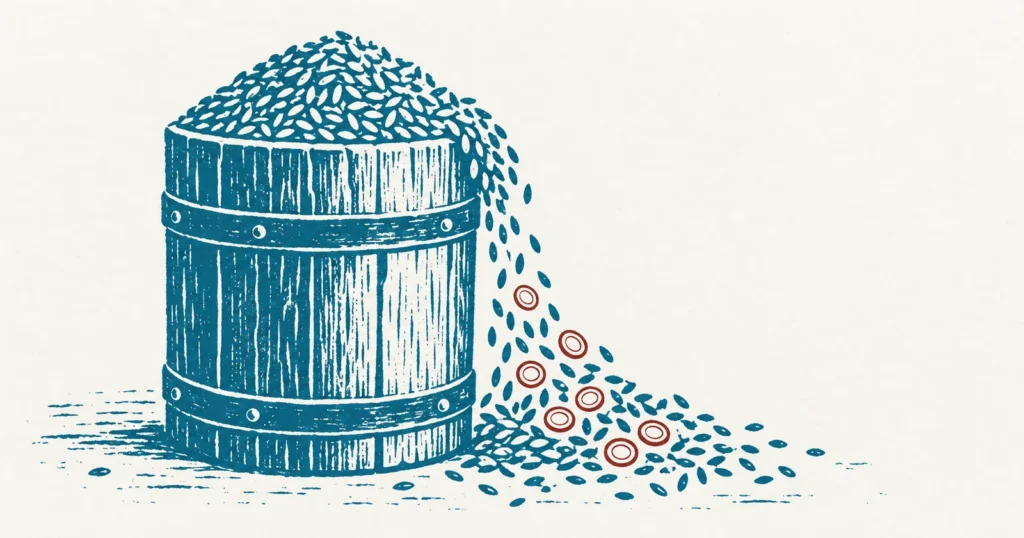
The rest of the verse is a picture from the grain market: “good measure, pressed down, shaken together, and running over.” A measure was the container grain was sold by. The measure you use with people, in judging and in giving, is the measure that comes back to you, and when you give, it comes back fuller than it went. Luke does not say in what. This verse is not a guarantee that money you send will come back to you as more money; the same speech tells you to lend to people who may never pay you back.
What comes before it
The speech in Luke 6 turns at verse 27, “love your enemies, do good to those who hate you,” and from there almost every line asks for something that will not be paid back. Bless the people who curse you. Offer the other cheek. “Give to everyone who asks you.” Then Jesus comes to lending, the place where most of us quietly expect a return.
If you lend to those from whom you hope to receive, what credit is that to you? Even sinners lend to sinners, to receive back as much. But love your enemies, and do good, and lend, expecting nothing back; and your reward will be great, and you will be children of the Most High; for he is kind toward the unthankful and evil.
Luke 6:34-35 (WEB)
Two things are promised side by side: your reward will be great, and you will be children of a Father who is kind to the unthankful and the evil. Before verse 38 promises anything, verse 34 has already asked the question that matters: what credit is that to you?
Then comes one hinge sentence, “Therefore be merciful, even as your Father is also merciful,” and the commands that end with the famous one.
Four commands, and three of them can be kept with empty pockets
Judge not, and ye shall not be judged: condemn not, and ye shall not be condemned: forgive, and ye shall be forgiven: Give, and it shall be given unto you; good measure, pressed down, and shaken together, and running over, shall men give into your bosom. For with the same measure that ye mete withal it shall be measured to you again.
Luke 6:37-38 (KJV)
The King James is the older wording. Newer translations, the World English Bible among them, say “it will be given to you,” and in verse 37 it has “set free” where the King James has forgive.
Four commands, then: judge not, condemn not, forgive, give. Only the last one needs anything in your hands, and even that one does not say what to give. Money is plainly included, since the same speech has just been talking about goods and lending. So is mercy. Someone with very little in November still has a measure, and it can be a generous one.
Verse 38 presses the grain down, shakes it so it settles, and fills the measure until it spills over, then empties it into the fold of a garment, which is what the King James means by bosom. A giver’s measure is returned fuller than it went.
The same measure in Matthew and Mark
Jesus used the measure line in more than one place. Matthew 7:2 puts it right after “Don’t judge”: “For with whatever judgment you judge, you will be judged; and with whatever measure you measure, it will be measured to you.” Read to the end of that paragraph and “judge not” turns out to end with you close enough to take a splinter out of somebody’s eye, and the measure is the same one. Mark 4:24 ties it to listening: “Take heed what you hear. With whatever measure you measure, it will be measured to you; and more will be given to you who hear.”
In Matthew the measure is tied to judging, in Mark to hearing, and in Luke to judging and giving together. The saying is about what comes back to you, and in Luke it comes right after “be merciful.”
When the giving is money
Paul runs the principle on a real collection, money gathered for “the poor among the saints who are at Jerusalem,” as he calls them in Romans 15:26. In 2 Corinthians 9:6 Paul writes, “he who sows sparingly will also reap sparingly. He who sows bountifully will also reap bountifully.” From verse 8 to the end of that chapter, each promise of increase says what it is for: “that you, always having all sufficiency in everything, may abound to every good work,” and “you being enriched in everything for all generosity, which produces thanksgiving to God through us.” In those verses he does not let a sentence about increase end before he has said where it goes, and where it goes is more generosity and thanks to God.
Proverbs 19:17 does speak of God repaying a giver: “He that hath pity upon the poor lendeth unto the LORD; and that which he hath given will he pay him again.” The giving that verse means goes to the poor, who cannot pay it back, and a gift sent in order to get more back is the kind of lending Luke 6:34 has already asked about. Two chapters later, the man who promised “all sufficiency in everything” writes that he has been “in hunger and thirst,” so the increase was never a promise that a generous person would not go hungry.
The measure in your hands
Before any gift, verse 34’s question comes down to this: would you still give it if nothing came back? Then it puts the measure in your hands. You decide how generously you judge, how quickly you forgive, and what you hand to the person who asks. The measure you hold out to other people at Thanksgiving is the one used for you, and a generous one is handed back pressed down and running over.