
Years ago I said something true and hard to a man I had known a long time. He told me judge not, and I apologized and let it go. Judge not is Matthew 7:1, and it means do not hold anybody to a standard you could not survive being held to yourself.
What I have thought since is that I was relieved. The verse handed me a way out of a conversation I didn’t want to be in, and I took it and called it humility.
Jesus says it to people he fully expects to go on telling right from wrong.
Four more verses follow it
Here is the whole of it, in the translation that fixed the saying in English.
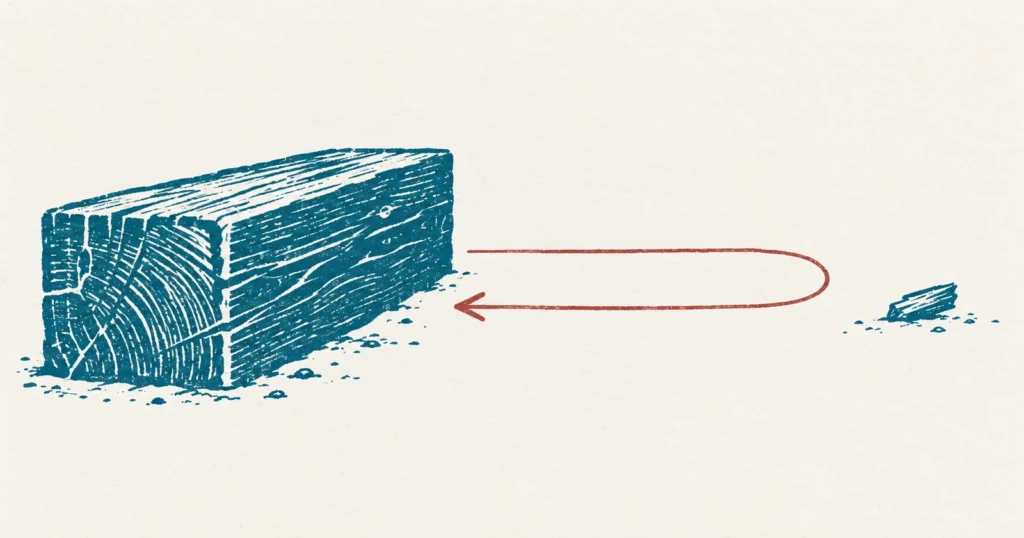
Judge not, that ye be not judged. For with what judgment ye judge, ye shall be judged: and with what measure ye mete, it shall be measured to you again. And why beholdest thou the mote that is in thy brother’s eye, but considerest not the beam that is in thine own eye? Or how wilt thou say to thy brother, Let me pull out the mote out of thine eye; and, behold, a beam is in thine own eye? Thou hypocrite, first cast out the beam out of thine own eye; and then shalt thou see clearly to cast out the mote out of thy brother’s eye.
Matthew 7:1-5 (KJV)
The first line is the half everybody knows. The second gives the reason, and it has to do with weights and measures. Then the beam and the mote, and then the line nobody quotes, where the one who can finally see straight is sent to go and finish the job.
Jesus never commands that last part. He assumes it. There is one imperative in the Greek of that last verse, cast out the beam, and what hangs off it is a future and then an infinitive: then you will see clearly, to take out your brother’s mote. First the beam, and the rest is expected of you. People quote the first line to prevent exactly that.
About “lest”
Most of us are quoting our memory of this verse. People say judge not, lest ye be judged, and the King James has “that ye be not judged.”
The memory is not wrong about the sense, though. The King James turns that same small Greek conjunction into lest over at Ephesians 2:9, “lest any man should boast.” One printing of the New American Standard, in 1977, put lest right here. The translators went another way at this verse and the language kept the other one.
He expects it three more times
The very next sentence out of his mouth needs it. Keep what is holy away from dogs, he says, and pearls away from pigs, and nobody follows that instruction without first deciding which is which.
Further down the same hillside he gets blunter.
“Beware of false prophets, who come to you in sheep’s clothing, but inwardly are ravening wolves. By their fruits you will know them,” in the World English Bible. By their fruits is an instruction to watch people and work out what you are looking at.
On another day, arguing with men who were angry that he had healed somebody on a Sabbath, Jesus put both halves in one sentence. “Don’t judge according to appearance, but judge righteous judgment,” John 7:24, World English Bible. The first half of that forbids judging. The second half commands it, and in Greek it is unmistakably a command.
A standard nobody could live under
A standard nobody could live under is what the paragraph forbids. The second verse says so plainly: the judgment you use is the judgment you get, and the measure you hand out is the measure handed back to you. Those verbs have God behind them, and the Good News Translation and the Contemporary English Version put him in by name. Paul makes the same point without the eye, in a letter to a church he had never visited. “For in that which you judge another, you condemn yourself. For you who judge practice the same things,” in Romans 2:1, World English Bible.
James is the hardest passage for the case I am making, so he goes in. He opens with “Don’t speak against one another, brothers,” names the one lawgiver “who is able to save and to destroy,” and then asks “who are you to judge another?” in James 4:11-12, World English Bible. James is guarding the verdict, the one about where a life finally lands. How it ends for you is God’s to say. Whether the man across the table is lying to you today is a question you are allowed to answer, and that second sentence is mine rather than James’s.
The permission is not free
The permission does arrive with a bill attached. Your own measure comes back to you, and your own beam comes out first. Paul hands the restoring to “you who are spiritual,” done “in a spirit of gentleness,” with an eye on yourself in case you are tempted next, in Galatians 6:1, World English Bible.
But the bill is not the point of the paragraph, and neither is the silence. Half a verse is a useful thing to own, and it is the same habit that put Philippians 4:13 on a wristband with the hunger left off. The line that ended my conversation is the one that lets everybody stay seated. By the end of the paragraph Jesus has you up and standing close enough to work on somebody’s eye, and nobody ever got that close by backing away.