
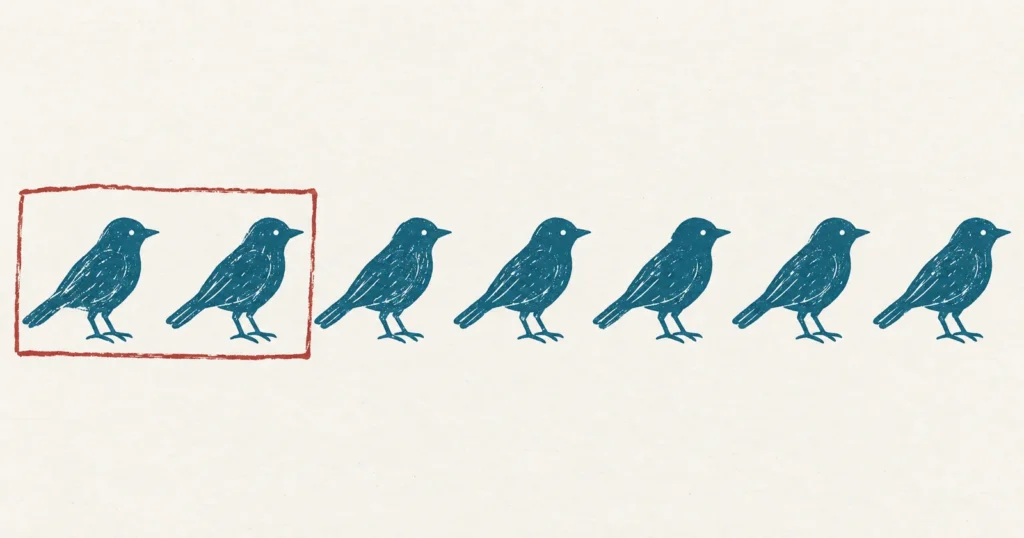
Not of all of them. Two of the unclean animals, and sevens of the clean ones and of the birds. The instruction gets revised between one chapter and the next, and the reason for the revision is sitting at the far end of the story.
Where two by two comes from
It is a real instruction and it is the first one given.
And of every living thing of all flesh, two of every sort shalt thou bring into the ark, to keep them alive with thee; they shall be male and female.
Genesis 6:19 (KJV)
Two of every sort. That is where the nursery gets its pairs, and nothing is wrong with it. The trouble is that people stop reading five verses too early.
The nursery version
I have taught the Noah story in the class I sometimes take on a Sunday, and I have not once mentioned the sevens. The version I was working from came from a nursery, where they deal in pairs because pairs make a better mobile, and I had never gone back to the chapter to check it against the instruction God actually gave twice.
None of this touches the parts that matter, and a child with a wooden ark is not being misled about anything important. What the chapter does that the decoration cannot is provide for a fire nobody will light until the flood has drained away, without once explaining itself.
Chapter seven revises it
Of every clean beast thou shalt take to thee by sevens, the male and his female: and of beasts that are not clean by two, the male and his female. Of fowls also of the air by sevens, the male and the female; to keep seed alive upon the face of all the earth.
Genesis 7:2-3 (KJV)
Clean beasts by sevens, birds by sevens, and the unclean still by twos. The earlier instruction has not been cancelled, it has been made specific, and the specificity turns out to matter.
The Hebrew of that sentence has a detail the English smooths over. For the beasts, clean and unclean alike, it says ish v’ishto, literally a man and his wife, the ordinary words for a married couple. For the birds it switches to zakhar u’neqevah, male and female, the plain biological terms. The animals going in to breed are described the way a household is described.
The phrase translated by sevens is shiv’ah shiv’ah, seven seven, and translators have never agreed on whether that means seven animals or seven pairs. The King James leaves it open with by sevens in both verses, and the American Standard with seven and seven. The World English Bible decides on seven pairs for the beasts, then prints seven and seven for the birds, where the Hebrew phrase is identical. Nobody is being careless; the Hebrew genuinely says it twice and leaves you to decide what the repetition is doing.
Then they went in two and two
The verse people quote against all this is the loading scene, and it does say two and two.
Of clean beasts, and of beasts that are not clean, and of fowls, and of every thing that creepeth upon the earth, There went in two and two unto Noah into the ark, the male and the female, as God had commanded Noah.
Genesis 7:8-9 (KJV)
Read it as a head count and it contradicts the sentence six verses above it. Read it as a description of how they arrived, which is what it says. There is no contradiction at all. They came in pairs. The passage is telling you the formation, not the total. The verse itself closes by saying they came in as God had commanded Noah, and the only command on record is the one with the sevens in it. It also makes a point of noting that clean and unclean both came in that way.
The reason is at the other end of the flood
Verse three gave one reason at the end of the instruction, to keep seed alive upon the face of all the earth. Here is the other one, which Genesis never states and only acts out.
And Noah builded an altar unto the LORD; and took of every clean beast, and of every clean fowl, and offered burnt offerings on the altar.
Genesis 8:20 (KJV)
The first thing that happens on dry land is a fire, and what burns on it is clean beasts and clean birds, which are exactly the two categories that were loaded in sevens.
Go aboard with two of a species and burn one, and you have ended it. The surplus is the margin that lets the story finish with a sacrifice instead of an extinction, and nobody in the text says so, because nobody in the text needs to. The instruction and the fire are a chapter apart and were written to be read together.
What changes on the other side
There is one more thing the ark story sets up and does not comment on. Before the flood the diet given to humanity is plants. Afterwards, in Genesis 9:3, every moving thing that lives becomes food.
The animals that came aboard in pairs walk off into a world where they can be eaten, and the ones that came aboard in sevens have already had at least one of their number burned on an altar. The boat is the last moment in Genesis when the arrangement between people and animals is simple.
Clean and unclean, centuries early
One more oddity, and then I will stop. The clean and unclean categories arrive in Genesis 7 without explanation, as though Noah already knows which is which, and the law that defines them is not written until Moses, centuries later.
Genesis does not treat this as a problem, and I have no solution to offer for it. What it shows is that the writer expected his readers to have the categories already, and that the flood story as we have it was told to people who did.
Genesis leaves the fruit unnamed on the same principle, and expects somebody to notice. Here the chapter stocks a boat for a sacrifice a chapter and a half away and never says so. You either count the extra animals or you do not. Nothing in the text nudges you.