
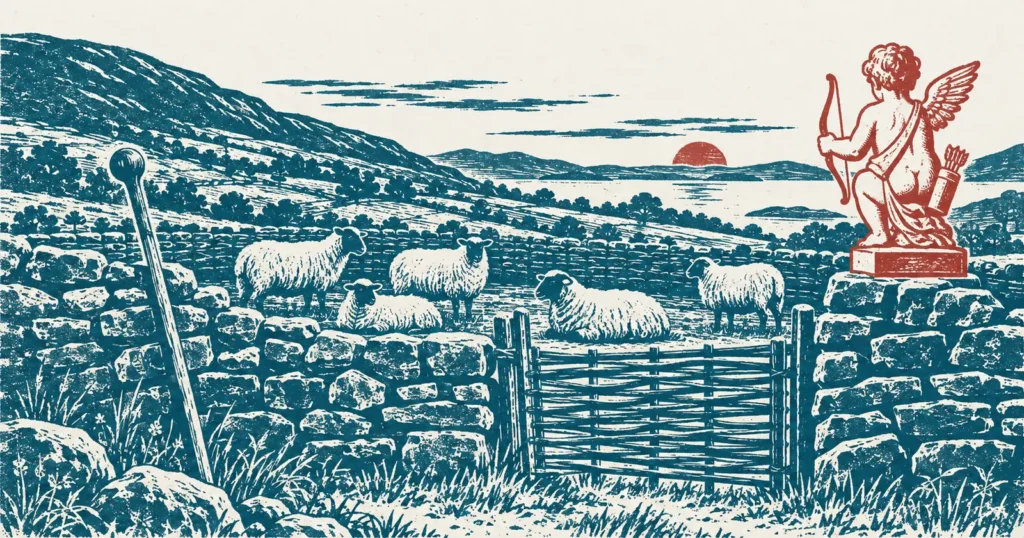
A tired parent brings it into the counseling room more often than they bring any verse, usually because an older relative handed it to them first. “Spare the rod, spoil the child” is not in the Bible. It comes from a comic poem of 1663, in which a widow tells a suitor he will have to be whipped before she will have him, and the child in the line is Cupid.
If you are being hurt at home, or you are frightened by what you might do, the Childhelp National Child Abuse Hotline takes calls and texts at 800.422.4453, at any hour, in the United States.
The line is a joke about courtship
Samuel Butler’s Hudibras is a satire, and by the second part its knight is trying to talk a widow into marrying him. She turns him down, tells him he can go and be whipped for her sake first and bring back a fair account of it, and then she reaches for her argument.
If matrimony and hanging go By dest’ny, why not whipping too? What med’cine else can cure the fits Of lovers when they lose their wits? Love is a boy by poets stil’d; Then spare the rod and spoil the child.
Samuel Butler, Hudibras, Part II, Canto I, 1663
Love is the boy. Spare the rod and you spoil him. A woman who is enjoying herself is arguing for the beating of a grown suitor, and the couplet reached church lobbies as advice on raising children. The line about mysterious ways traveled the same road, out of a hymn of 1773 that does not say works.
Proverbs does have a rod in it
Leaving this part out is how the saying keeps its grip, so here it is.
He that spareth his rod hateth his son: but he that loveth him chasteneth him betimes.
Proverbs 13:24 (KJV)
And the passage that rarely gets read aloud by the people quoting the first one:
Withhold not correction from the child: for if thou beatest him with the rod, he shall not die. Thou shalt beat him with the rod, and shalt deliver his soul from hell.
Proverbs 23:13-14 (KJV)
The rod is in Proverbs eight times, counting the two above: 10:13, 13:24, 22:8, 22:15, 23:13, 23:14, 26:3 and 29:15. So anybody who tells you Scripture says nothing about a rod has not read the book.
Four of them are about a child, and they are the four worth arguing about: 13:24, 22:15, 23:13-14 and 29:15. The rest go to a fool’s back, to a man void of understanding, and to a man’s own anger.
Permission is not mine to give
I counsel two evenings a week, and what I will not do in that room is hand a parent a line as permission, least of all one that is not from Scripture. Where the boundary falls inside your own house I will not say, because I haven’t been asked and I would be guessing at it.
Both words are worth looking up
The noun is shevet, and it is the same word in all eight. It is also the noun in a line most people can finish from memory, “thy rod and thy staff they comfort me,” in Psalm 23:4. A shepherd’s rod, for counting sheep and for going at whatever comes out of the dark at them.
None of that makes the verses in Proverbs gentle. The lexicon settles one thing only: what the instrument was before anybody made it an argument.
The second word is the one printed as child. Three of the four child passages have na’ar, which Scripture uses of Joseph at seventeen and of Absalom commanding an army against his own father, so the person being corrected is frequently not small. The fourth, 13:24, says son.
The word printed as hell
Read those two verses in Proverbs 23 together and the second answers the first. He shall not die, says the thirteenth, and then the fourteenth: deliver his soul from hell.
The noun there is sheol, and the King James prints the same noun as the grave in Genesis 37:35, where Jacob says he will go down into it mourning for his son. His son was Joseph, the seventeen-year-old from a paragraph ago.
Damnation is not the subject of the couplet. A young man on a road that gets people killed is the subject, and so is a father who would rather have him alive.
A proverb is not a promise
The book opens by saying what it is for, which is to give the young man knowledge and discretion, in Proverbs 1:4. A book about how life generally runs, handed to somebody on his way out the door.
Whoever assembled it made the point himself, on purpose. Proverbs 26:4 says answer not a fool according to his folly. The very next verse says answer a fool according to his folly. Both are printed, one under the other, and the man who set them there was not confused. A proverb tells you what is usually true, and working out which one the day in front of you calls for is the job.
Which is why a proverb can be perfectly true and still fail in your house, without either you or the proverb having done anything wrong.
Twice, the letters turn to parents
Paul reaches the parents in the room only twice, and hands them a brake both times. To Ephesus he says do not provoke your children to wrath, and then names what to do instead.
You fathers, don’t provoke your children to wrath, but nurture them in the discipline and instruction of the Lord.
Ephesians 6:4 (WEB)
To Colossae it is shorter. “Fathers, don’t provoke your children, so that they won’t be discouraged.” Those are Paul’s only two direct addresses to fathers, and each one opens with the father’s temper before it gets to the child.
Anybody defending the rod from the New Testament will reach for Hebrews rather than Paul. That chapter tells a son not to despise the chastening of the Lord, quoting Proverbs 3 to do it, and then says the Lord scourges every son he receives. The father there is God and the house is not yours, and it is still the strongest thing on that side of the argument.
So when the sentence gets defended, check which one is being defended. Four passages in Proverbs will bear defending. A widow in a comic poem, telling a suitor he will have to be whipped first, will not.