
The family room on a surgical floor has the verse on the wall, in a frame. A man I sat with there read it out loud once, in the fourth hour, the way you read a sign you have already passed twice. I have never worked out whether the frame helps. The best reading of it is that the words were first aimed at nations that would not put their weapons down. Jeremiah 29:11 has the same trouble, written to a deported nation and read off a sign as a forecast about your year.
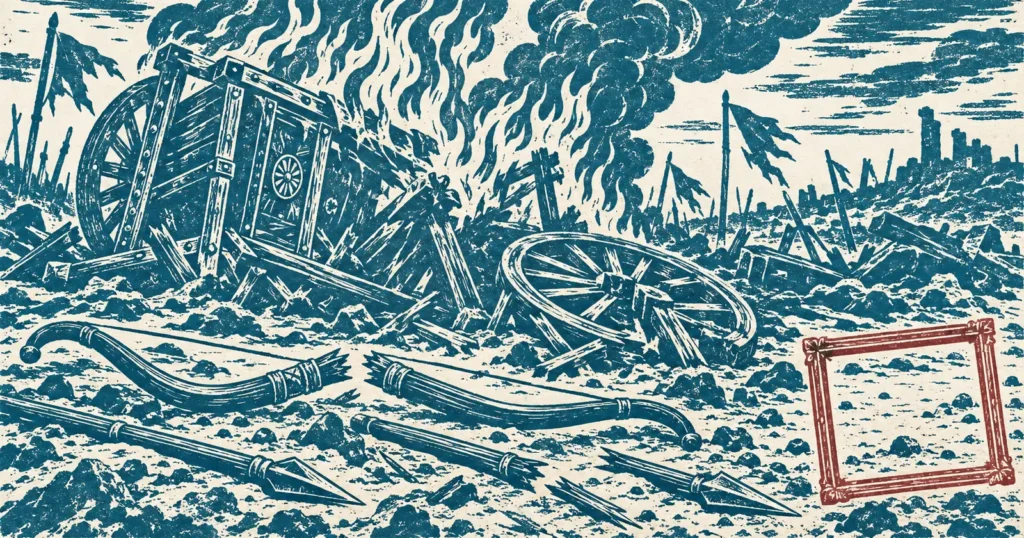
One line above it, a chariot burns
Come, behold the works of the LORD, what desolations he hath made in the earth. He maketh wars to cease unto the end of the earth; he breaketh the bow, and cutteth the spear in sunder; he burneth the chariot in the fire. Be still, and know that I am God: I will be exalted among the heathen, I will be exalted in the earth.
Psalm 46:8-10 (KJV)
The heading gives the psalm to the sons of Korah, which means a choir sang this, in a city that could be besieged, about a city that could not be moved.
Bows, spears, a chariot on fire. Then the sentence everybody knows, and then the rest of the sentence, which nobody frames: I will be exalted among the nations.
The psalm has been loud from the start. Mountains carried into the sea, waters roaring, kingdoms moved, and God uttering his voice, and the earth melted. Into that, the command. Nobody is being invited to a peaceful morning, and the imperative is plural, which is not how you address one person in a chair. That is what you say to people who will not put the weapons down.
A good many translations print stop
Most English Bibles keep be still, and it sounds like a hand on your shoulder. A good many do not, including two whole translation families, and those repay reading. The Hebrew verb behind it is the one used for a hand going slack. The lexicons give it both ways at this verse, let go and be quiet, which is the honest reason the committees split, and not a reason to call the common reading wrong.
The New English Translation prints “Stop your striving” at Psalm 46:10. The Christian Standard Bible prints “Stop fighting,” and the Holman before it had “Stop your fighting.” The 1995 New American Standard had “Cease striving,” and the current edition has “Stop striving.” Each of them puts in a word the Hebrew does not supply, and the two New American Standard editions mark it, printing striving in italics.
The verb there is an imperative, and the King James gives that same verb three other jobs when somebody else says it. God says it to Moses in Deuteronomy and the King James prints let me alone. Samuel says it to Saul, and it is Stay. And a psalm puts it in front of a line about a man’s own temper, where the King James prints Cease from anger, which is very close to the word the New American Standard reached for here. The committees printing stop are following what the King James itself does with this verb, as an imperative, everywhere except here.
None of them is a correction to the King James. The older English is doing something it did well. They are committees looking at a verse everybody else renders as a hand on the shoulder and deciding to print stop.
Moses at the sea, in the same position
The people are pinned against the water with an army behind them, and Moses tells them what to do about it.
And Moses said unto the people, Fear ye not, stand still, and see the salvation of the LORD, which he will shew to you to day: for the Egyptians whom ye have seen to day, ye shall see them again no more for ever. The LORD shall fight for you, and ye shall hold your peace.
Exodus 14:13-14 (KJV)
Nobody in that crowd is having devotions. They are being told to stop doing the one thing they were about to do, which is to run, or to fight, or to go back to Egypt and apologize. Stillness in both places is what happens when you stop taking the thing into your own hands, and it looks less like calm than like standing there empty-handed while an enormous thing happens in front of you.
It has carried people, and still does
Somebody is going to say the verse has carried them through a bad year, and that an article about bows and spears is taking it away from them. Nothing here takes it away, and the psalm is the reason.
God is our refuge and strength, a very present help in trouble.
Psalm 46:1 (KJV)
The psalm opens there, in the plural, sung by people who had a city to lose, and it does both jobs. The tenth verse gives that first line its footing. The one still standing at the end of the psalm is God, and that does not depend on how anybody in the waiting room feels about it.
Why I wanted it small
I have used this verse the small way for years, and I would rather it stayed small. The small reading is manageable. It asks me to settle myself before work, which I can do, or can at least perform, and it hands me a thing to be good at.
The large reading asks nothing of me at all. That is worse. Stop. I am not the one holding this together, and being told so is harder to take than an instruction, because an instruction at least gives me a job.
Bigger than the frame it hangs in
Most of the sayings in this series shrink when you read the paragraph around them, and this one does the opposite.
If Psalm 46:10 is about a still morning, it belongs to people who have mornings like that available, and on a surgical floor almost nobody does. Read it in its own paragraph and it belongs to anybody pinned down by a thing they cannot fix, which is everybody in the building, and it is not asking them to feel peaceful. The verse names who will be standing when this is over.
The psalm ends with the same line it used four verses earlier, that the LORD of hosts is with us and the God of Jacob is our refuge. Psalm 91 says refuge too, and Psalm 121 says the one who watches over you does not sleep, and Isaiah 26 promises peace to the mind that stays on him. None of those four is a technique.
I still read it the small way most mornings. Verse nine comes first now. There is a burning chariot in the room before I get to the sentence.