
At the end of twelve months, Nebuchadnezzar walked in his palace in Babylon and admired what he had built. A year before, he had been warned. People have a saying for what happened next, and it is in the Bible almost word for word, though the verse says more than the saying does.
Pride goeth before destruction, and an haughty spirit before a fall.
Proverbs 16:18 (KJV)
The popular line takes pride from the first line and the fall from the second. The two lines say the same thing two ways, so joining them keeps the sense. What the saying leaves out is the heavier word: where the second line says a fall, the first says destruction.
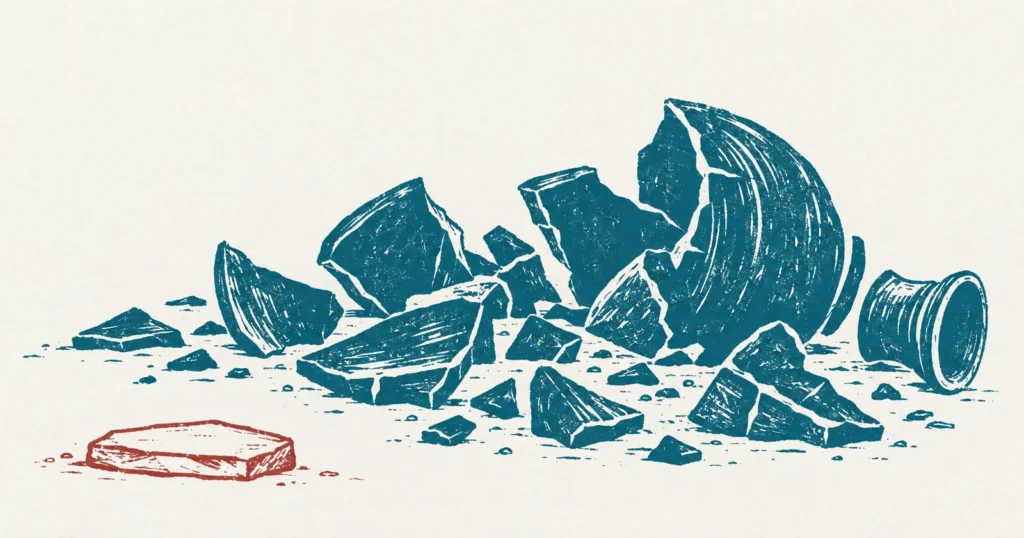
That word is heavier than it looks in English. Isaiah uses the same word in two neighboring verses of his thirtieth chapter, warning a people who despised the word they were given. Once it is a high wall bulging outward, “whose breaking cometh suddenly at an instant.” Then it is a potter’s vessel broken so thoroughly that no piece is left big enough to dip up water from the pit. Height, then a sudden breaking, then nothing left to use. Isaiah could have been drawing the proverb.
Proverbs says it twice
Two chapters later the book says it again, and this time it adds the other road.
Before destruction the heart of man is haughty, and before honour is humility.
Proverbs 18:12 (KJV)
“Before honour is humility.” That second line is worth carrying around with the first, because it says what to do instead.
How long the road can be
Proverbs 16:18 says where pride is headed and leaves the distance open. A proverb tells you how life generally runs, which is what this series found in the verse about training up a child, and this one does not say when.
Nebuchadnezzar’s road was a year long. Daniel had explained the king’s dream to him and added his own counsel: “break off thy sins by righteousness, and thine iniquities by shewing mercy to the poor; if it may be a lengthening of thy tranquillity.” At best it would have lengthened his peace, and twelve months later he was boasting.
Daniel’s counsel shows what humility does with its hands. It stops, it puts right what it can, and it is merciful to people who cannot repay it. Proverbs points the same way one verse after 16:18: “Better it is to be of an humble spirit with the lowly, than to divide the spoil with the proud.”
The king spake, and said, Is not this great Babylon, that I have built for the house of the kingdom by the might of my power, and for the honour of my majesty?
Daniel 4:30 (KJV)
My power, my majesty. “While the word was in the king’s mouth, there fell a voice from heaven,” and the kingdom was gone.
When the proud seem to do fine
Anyone who has watched an arrogant person prosper will want to ask this proverb about it, and the Bible asks first. The writer of Psalm 73 says, “I was envious at the foolish, when I saw the prosperity of the wicked,” and pride “compasseth them about as a chain.” Trying to make sense of it, he says, “was too painful for me; Until I went into the sanctuary of God; then understood I their end.”
His answer is the one the proverb gives, arriving late: “Surely thou didst set them in slippery places: thou castedst them down into destruction.” He reports the delay honestly. He does not pretend he had not seen what he saw.
The stump in the ground
The way back, for Nebuchadnezzar, came after the fall and not instead of it. He was told in advance that something would be left standing, and Proverbs makes no such promise to every proud man. Psalm 73 ends its proud men “utterly consumed with terrors.” But the king’s warning promised the stump from the start.
And whereas they commanded to leave the stump of the tree roots; thy kingdom shall be sure unto thee, after that thou shalt have known that the heavens do rule.
Daniel 4:26 (KJV)
When the appointed time was over, his return began with one movement: “I Nebuchadnezzar lifted up mine eyes unto heaven, and mine understanding returned unto me, and I blessed the most High.” That is the humility Proverbs puts before honor, and his honor did come back to him with his kingdom.
For anyone who recognizes themselves in the first line of the proverb, Daniel’s counsel is open before any fall comes: break off what you can, and show mercy where nothing comes back. He promised the king only that it might lengthen his peace, and it was still the right counsel. The king’s own first move is open too. On an ordinary Tuesday it can be as plain as giving God the credit, out loud or under your breath, for the thing you were about to brag about.
Pride travels toward a fall, and the road the Bible names instead is humility. The man who had said my power and my majesty finishes his account praising someone else’s: “Now I Nebuchadnezzar praise and extol and honour the King of heaven.”